Bioinformatics Research
Single-Cell Biology
Making sense of single-cell atlases, and how well what's learned from one transfers to another.
scGPT hyperparameter transfer across tissues
A 2026 Bioinformatics paper found that Bayesian-optimized fine-tuning settings meaningfully improve scGPT — a single-cell foundation model — at integrating multi-omic data, but only tested this on bone-marrow blood cells. Does that same already-tuned configuration still work when reused, unmodified, on a different tissue, or does it need its own expensive re-optimization? Surfaced by cross-checking three independent AI “deep research” runs against each other for genuinely open questions.
Read the full write-up → — all three regret tables, the UMAP figures, and the data behind them. Notebooks and results are public at github.com/kaysagit/scgpt-hyperparameter-transfer.
| Data | Source paper's own released bone-marrow (BMMC, CITE-seq RNA+protein) benchmark and winning hyperparameters, decoded directly from its published code. Three independent target datasets, each verified real and correctly formatted, then built into a clean dataset: a non-small-cell lung cancer CITE-seq atlas (17,608 cells, 8 patients), a head & neck cancer tumor+lymph-node CITE-seq dataset (20,488 cells, 3 patients — reached after a planned candidate, melanoma, turned out structurally unsuitable), and a healthy-donor PBMC reference (24,998 cells, 8 donors). |
|---|---|
| Method | Fine-tune scGPT on each target dataset two ways: (a) the bone-marrow-derived settings, frozen and reused as-is, vs. (b) a fresh, small hyperparameter search run on that tissue — then compare integration quality (biological conservation, batch-effect removal, rare-cell-type recovery) between the two. |
| Compute & cost | Free Colab T4 for verification and data-prep runs; Colab Pro/Vast.ai GPU for the fine-tuning searches · €0–15 spent so far |
| Deliverable | A “regret” table per dataset — how much integration quality is lost by reusing someone else's already-tuned settings instead of paying for a fresh search on the new data. Three datasets in: each fails (or doesn't) in its own way — two tumor datasets each have exactly one real exception, on two different metrics, while the healthy-blood dataset has none — the strongest sign yet that transfer quality is dataset-dependent rather than one universal rule. |
| Baseline to beat | Not an external benchmark — the comparison is internal (reused config vs. a fresh search on the same data). |
| Pitfall watch | Ground-truth cell-type labels must come from each dataset's own independent annotations, never the model's own output, or the “integration quality” score becomes circular. Held-out evaluation cells are kept completely separate from every fine-tuning run. A dataset's own patient count matters too — a metric that "transfers well" can still be riding on one patient's cells if there are only a few in the cohort (found and flagged for the 3-patient HNSCC dataset; confirmed not an issue for the 8-donor PBMC dataset). |
| Risk | Low — all three target datasets are verified and all three fine-tuning results are in and independently checked; main remaining work is the final write-up. |
Epigenetics & Aging
How well a molecular signal — DNA methylation — tracks the number that supposedly matters least in biology and most everywhere else: age.
Replicating Horvath's epigenetic age clock
In 2013, Steve Horvath showed that DNA methylation levels at a specific set of 353 CpG sites predict a person's chronological age to within about 3.6 years — one of the most independently-replicated results in aging biology, and the foundation the whole later family of "epigenetic clock" biomarkers (Hannum, PhenoAge, GrimAge) built on. This project checks that result directly: take Horvath's own published coefficients, unmodified, and score them against a real cohort that was never used to build the clock, to see how close the prediction actually lands.
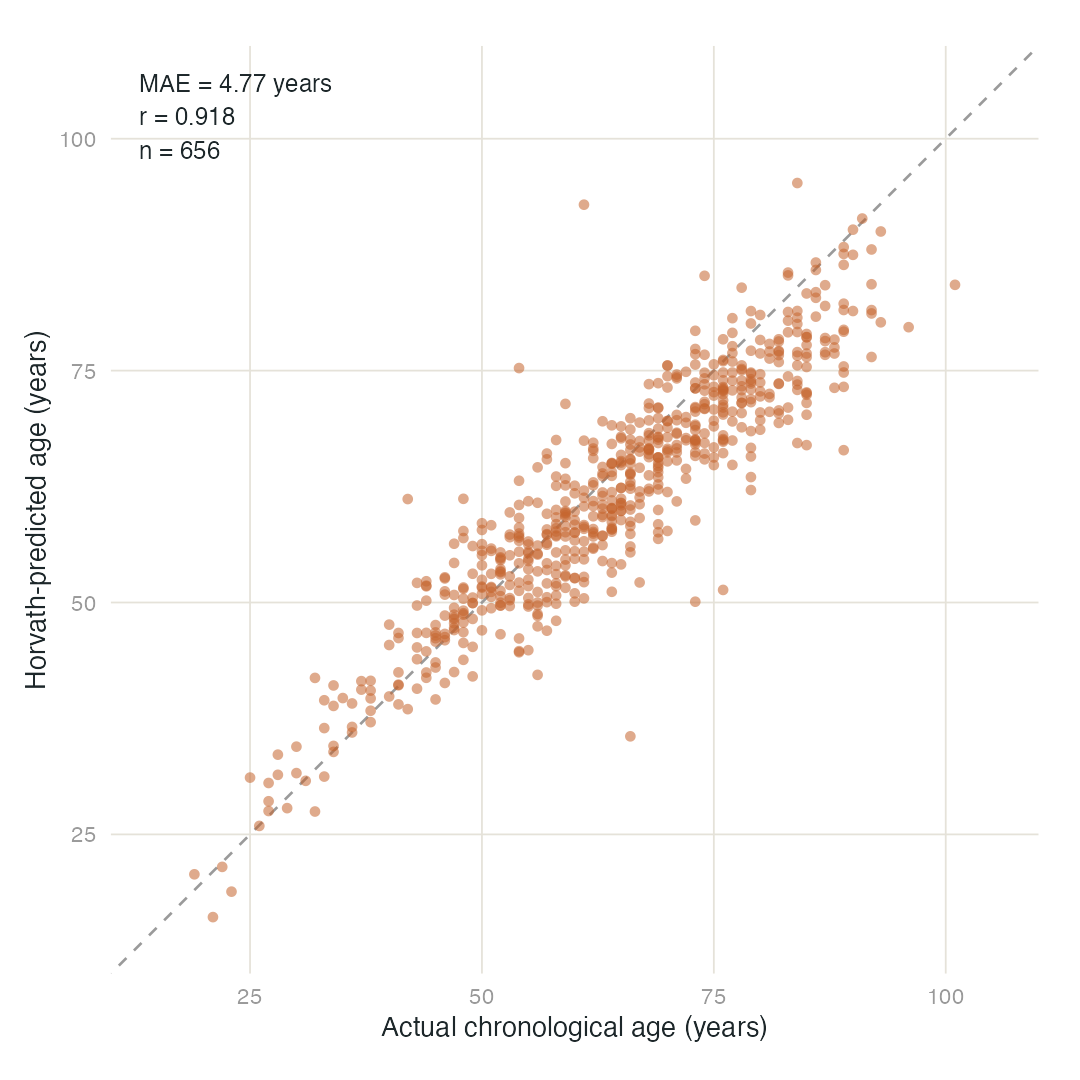
Scored zero-shot (no retraining) against 656 real whole-blood samples from an independent cohort (Hannum et al. 2013): MAE 4.77 years, r=0.918, comfortably clearing the sanity floor of 11.91 years (always predicting the mean). The gap versus Horvath's own reported 3.6-year MAE is expected, not a concern — this cohort was used to build a different clock (Hannum's), never Horvath's, so this is genuine cross-cohort external validation rather than an in-sample number.
| Data | Horvath's own published 353-CpG clock coefficients (via the methylclock R/Bioconductor package). Validation cohort: GSE40279 (Hannum et al. 2013), 656 real whole-blood samples, Illumina 450K methylation array, fully public GEO data. |
|---|---|
| Method | Apply Horvath's already-published, externally-trained coefficients directly to an independent cohort's methylation data — zero-shot, no retraining or fitting on this data at all — then compare predicted vs. real chronological age. |
| Compute & cost | Local CPU only (R/Bioconductor) · €0 spent — the only real cost was environment setup time, not compute |
| Deliverable | Mean absolute error against Horvath's own ~3.6-year benchmark, a predicted-vs-actual scatter, and a batch-leakage check. Result: MAE 4.77 years, r=0.918 — replicates. |
| Baseline to beat | Horvath's own ~3.6-year MAE is the number to match. Sanity floor: beat "always predict the training set's mean age" (11.91 years here) — cleared by a wide margin. |
| Pitfall watch | GEO methylation cohorts are pooled from separate processing batches; a model can look deceptively accurate if batch identity happens to correlate with age. Checked directly: none of this cohort's 9 plates is confined to a narrow age range. |
| Risk | Low — extremely well-documented ground truth, and the result is already in and checked. |
Cancer Immunology & Neoantigens
When a tumor's DNA mutates, the resulting altered proteins can get displayed on the cell surface for the immune system to recognize — a displayed mutant fragment is a neoantigen, and it's the basis of most modern cancer immunotherapy. Which mutations actually produce ones the immune system notices is still one of the field's open questions.
Immunogenicity-aware neoantigen landscape of chromophobe kidney cancer
Chromophobe renal cell carcinoma (KICH) is a rare, understudied kidney cancer with a distinctive genomic quirk: relatively few point mutations, but a disproportionate share of small insertions/deletions (indels). An indel that shifts the DNA reading frame produces a stretch of protein sequence the immune system has never seen — and frameshift-derived neoantigens are reported in the literature as unusually immunogenic. Nobody had pointed a modern immunogenicity-aware scorer (not just a binding-affinity predictor) at this specific cancer type before. This project builds that catalog from scratch and tests whether that expectation holds up here.
The original angle — benchmarking immunogenicity predictors against each other — turned out to be oversaturated by well-resourced 2023–2026 papers already doing exactly that; this project instead points an established scorer (PRIME2.1) at real, previously-unanalyzed patient data. One real, disclosed limitation runs through every result below: true per-patient HLA genotypes turned out to be gated behind restricted-access archives everywhere checked, so every candidate is scored against a fixed population-representative panel of common HLA-I types, not each patient's real genotype.
Correction, 2026-08-18: the finding originally published here (frameshift candidates score less immunogenic than missense, p≈3×10⁻¹⁸) was retracted after external review caught a pseudoreplication bug: the significance test ran on all sliding-window candidate peptides as independent observations, but frameshift mutations mechanically generate ~2.7× more overlapping peptide-windows per event than missense mutations, inflating the p-value asymmetrically. Re-run correctly at the mutation level (one representative peptide per mutation, n=66 frameshift vs. 865 missense): no significant difference, p=0.54. Fixing the same bug in the burden metric used for survival analysis had the opposite effect — it turned a previously-dismissed result into the project's one real finding, below.
Headline result (corrected): immunogenicity-weighted neoantigen burden associates with worse survival in this cohort (Cox HR=2.14, p=0.00073; log-rank p=0.0092 — the two tests now agree, and the result survives removing the single largest-burden patient). The originally-published mutation-type comparison and the immune-infiltration correlation are both honest null results; only the survival association held up under a corrected, non-inflated analysis. Caveat carried forward plainly: this rests on only 65 patients and 9 observed deaths (8 without the outlier) — a real, worth-following-up signal, not a definitively established one.
| Data | TCGA-KICH somatic mutation calls (GDC's current per-patient pipeline, 66 patients), RNA-seq gene expression and clinical/survival data (GDC, all open-access), reference protein and coding sequences (Ensembl REST API). |
|---|---|
| Method | Custom mutation→peptide pipeline (missense: direct substitution against the reference protein; frameshift: real CDS-coordinate translation to the new stop codon) scored against a fixed 10-allele HLA-I population panel with PRIME2.1 + MixMHCpred3.0, since true per-patient HLA genotypes are not openly accessible for this cohort. |
| Compute & cost | Fully local CPU · €0 spent |
| Deliverable | The first immunogenicity-aware, mutation-type-stratified neoantigen catalog for this cancer type. Corrected headline (2026-08-18): immunogenicity-weighted burden associates with worse survival (Cox & log-rank agree, FDR-surviving, outlier-robust) — the mutation-type comparison originally published here did not survive a corrected, non-pseudoreplicated test and is now an honest null result. |
| Baseline to beat | No existing baseline for this exact analysis — that's the point. Original sanity check (frameshift scores more immunogenic than missense) came back null once tested correctly at the mutation level, not one direction or the other. |
| Pitfall watch | Scored against a population HLA panel, not real per-patient genotypes (five sources checked, all gated). A real pseudoreplication bug (sliding-window peptides treated as independent observations) was caught by external review 2026-08-18 and fixed — see the tech log. Multiple-testing correction re-applied across the corrected claims. |
| Risk | The surviving survival finding rests on only 65 patients / 9 deaths (8 without the largest-burden outlier) — reported as a real, hypothesis-generating signal, not a definitively established one. Mutation-type and immune-infiltration results are both honest nulls. |
Frameshift vs. missense immunogenicity in MSI-High gastric cancer
A direct follow-on to the KICH project: after that project's original mutation-type finding turned out pseudoreplicated and null once corrected — at only 66 frameshift mutations, too few to detect anything but a large effect — this project reruns the identical corrected pipeline (PRIME2.1 + MixMHCpred3.0, same fixed 10-allele HLA-I panel, mutation-level aggregation built in from the start) on a cohort chosen specifically to have the statistical power KICH lacked: the MSI-High subset of TCGA-STAD (gastric adenocarcinoma), a classic mismatch-repair-deficient hypermutator with indels concentrated in mononucleotide-repeat slippage — a deliberately different mutational mechanism than KICH's own non-MSI indel skew.
80 MSI-High patients identified via two independent open sources (cBioPortal's MSIsensor score and TCGA's own published molecular subtype), cross-validated against each other. Real data confirmed via GDC's current mutation pipeline: 23,808 frameshift indels across all 80 patients (vs. KICH's 88 across 43/66) — every single patient has both mutation types, unlike KICH's 35% with zero frameshift mutations, making a per-patient paired comparison possible for the first time.
Where this stands: the question has split in two — the headline half is resolved, a narrower half is under active test. An equal-N subsampling check (2026-09-02) removed the window-count confound by construction: for every mutation, sample a fixed number of candidate windows before taking the best score, so both arms feed the same number of draws into the best-of-N. Across every configuration the naive effect collapses — rank-biserial r falls from 0.14 to |r| ≤ 0.05 — and the cleanest apples-to-apples comparison (frameshift mutations whose window count genuinely overlaps missense's, both subsampled to a common N) is a flat null: p=0.66. So at the level of a whole mutation event, a frameshift does not make its best candidate neoantigen meaningfully more or less immunogenic than a missense one, once frameshift stops getting more attempts at the target. That confirms the KICH project's corrected null at ~240× the frameshift sample size; the p=7×10−141 was almost entirely the multiplicity artifact.
What remains is a per-peptide question: holding the number of attempts exactly equal, is a frameshift-derived peptide itself scored differently? Compared strictly within bins of identical candidate-window count — and deduplicated against the MSI-High habit of producing the same neo-ORF peptide at recurrent slippage hotspots — this is not a flat null: it changes sign with neo-ORF length. Frameshift scores worse for short novel reading frames and better for long, well-expressed ones; in the bin matching a normal full-length missense mutation, frameshift is favored at p=9×10⁻¹². Whether that is real per-peptide biology or an artifact of PRIME's %Rank scale at its extremes was checked with a structure-aware second opinion: ColabFold structures for the 302 contested peptide-MHC complexes, re-scored by ImmunoStruct (a 2025 model built on predicted structure and biochemistry, not just sequence, trained independently of PRIME). The result does not corroborate PRIME's signal — flat null (p=0.91, rank-biserial r=−0.008; a feature-sensitivity variant agrees). It isn't simply noise: ImmunoStruct's own scores still correlate with PRIME's %Rank within this set (Spearman=−0.19, p=7×10⁻⁴) — it specifically doesn't see a class-level frameshift effect where PRIME sees a large one. Honest read: the per-peptide question is now unresolved rather than confirmed reversed-to-null; PRIME's signal alone looks meaningfully weaker under an independent, structure-aware model. The available ImmunoStruct checkpoint is infectious-disease-trained rather than cancer-trained, so a stronger cancer-specific comparative check (folding the wild-type peptides too) is the natural next step, not yet run.
| Data | TCGA-STAD MSI-High somatic mutation calls (GDC's current per-patient pipeline, 80 patients), RNA-seq gene expression (GDC, 76/80 patients), reference proteome/CDS (bulk Ensembl FASTA, release 114). MSI-High status from two independent open cBioPortal sources (MSIsensor score, TCGA molecular subtype). |
|---|---|
| Method | Same corrected pipeline as the KICH project: custom mutation→peptide generation, PRIME2.1 + MixMHCpred3.0 against the identical fixed 10-allele HLA-I population panel, mutation-level aggregation (not peptide-level) from the start. Window-count confound controlled by equal-N subsampling. Follow-up structure-aware check on the contested subset: ColabFold peptide-MHC structures re-scored by ImmunoStruct. |
| Compute & cost | Local CPU for the full scoring pipeline (€0); Colab T4 (ColabFold + ImmunoStruct) for the ~300-complex structure-aware check — first cloud spend on this project, small, within the €50–100 budget. |
| Deliverable | A properly-powered test of whether frameshift-derived neoantigens differ in immunogenicity from missense-derived ones. Event-level answer reached (null, at ~240× KICH's power). The per-peptide sub-question — a neo-ORF-length-dependent effect in PRIME alone — did not survive an independent structure-aware re-score; now unresolved rather than confirmed either direction, pending a cancer-trained comparative check. |
| Baseline to beat | KICH's own corrected null result (p=0.54, underpowered) — this cohort has ~240x more frameshift mutations, so a real answer either direction would be informative. |
| Pitfall watch | The pseudoreplication class of bug from KICH is designed out here. A second multiplicity confound (unequal candidate-window counts per mutation between arms) was found and resolved via equal-N subsampling. Recurrent MSI-High hotspot peptides are a third pseudoreplication trap, now deduplicated in the per-peptide analysis. |
| Risk | Low on the event-level conclusion — a stable null under the strongest available control that matches an independent cohort. The per-peptide sign-flip was cross-checked against a second, structure-aware model rather than published as-is, and came back null — but the available checkpoint is infectious-disease- not cancer-trained, so that isn't fully decisive either. Low on data quality throughout. |
Genome Language Models
Foundation models trained directly on raw DNA sequence, and whether what they learn transfers to predicting the real-world consequences of a mutation — without ever looking at a protein sequence, a structure, or an alignment.
Zero-shot variant-effect prediction in bacteriophage ΦX174 with a DNA language model
A 2026 preprint (Wei, Li & Lehner) measured the fitness effect of essentially every possible mutation across bacteriophage ΦX174's genome — every single-nucleotide substitution and every single-amino-acid substitution, ~44,500 variants in total — then benchmarked roughly 15 protein-sequence variant-effect predictors (the ESM family, EVE, GEMME, VESPA, Progen2, and more) against the real measurements. Every one of those predictors reads protein sequence, or a multiple-sequence alignment built from many related proteins; none of them look at DNA directly. This project fills that specific gap: Evo2, a genome-scale DNA language model pretrained across bacteria, archaea and phage, scored zero-shot on the exact same benchmark.
Method: for each of the 44,478 designed mutations, compare Evo2's own likelihood of the mutant genome against the wild-type genome — a bigger drop in likelihood means the model finds that specific DNA change more disruptive — and correlate that drop against the mutation's real, lab-measured effect on phage fitness, gene by gene, using the paper's own metric (per-gene Spearman correlation).
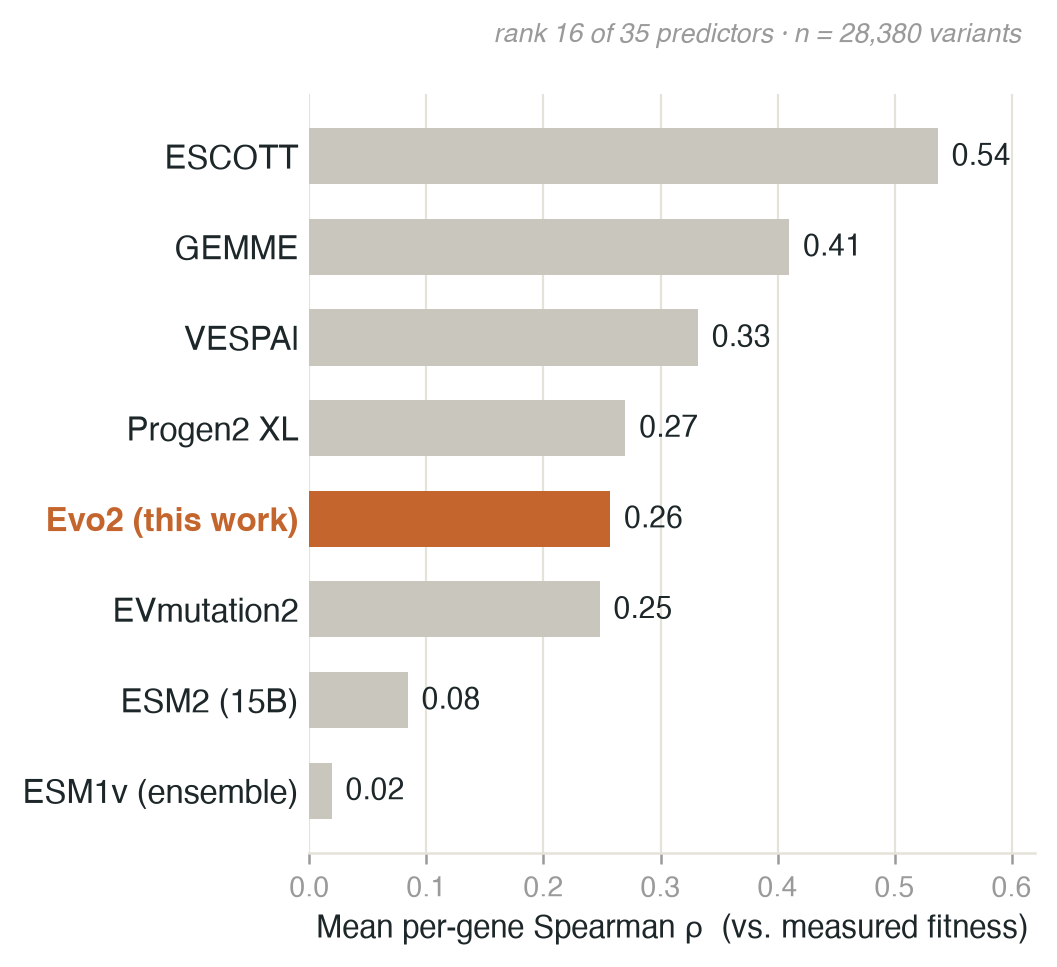
At the amino-acid level — the paper's own benchmark, identical rows, identical metric — Evo2 ranks 16th of 35 predictors (mean per-gene Spearman ρ=0.257, median 0.329, n=28,380 variants). A model that has never seen a protein sequence or a multiple-sequence alignment beats every single ESM-family model tested (ESM1v, ESM2 up to 15B parameters, ESM3, ESMC up to 6B), plus Tranception and PoET — while trailing the structure-aware and MSA-based specialists (ESCOTT, GEMME) and the best single-sequence protein language models (VESPA, Progen2).
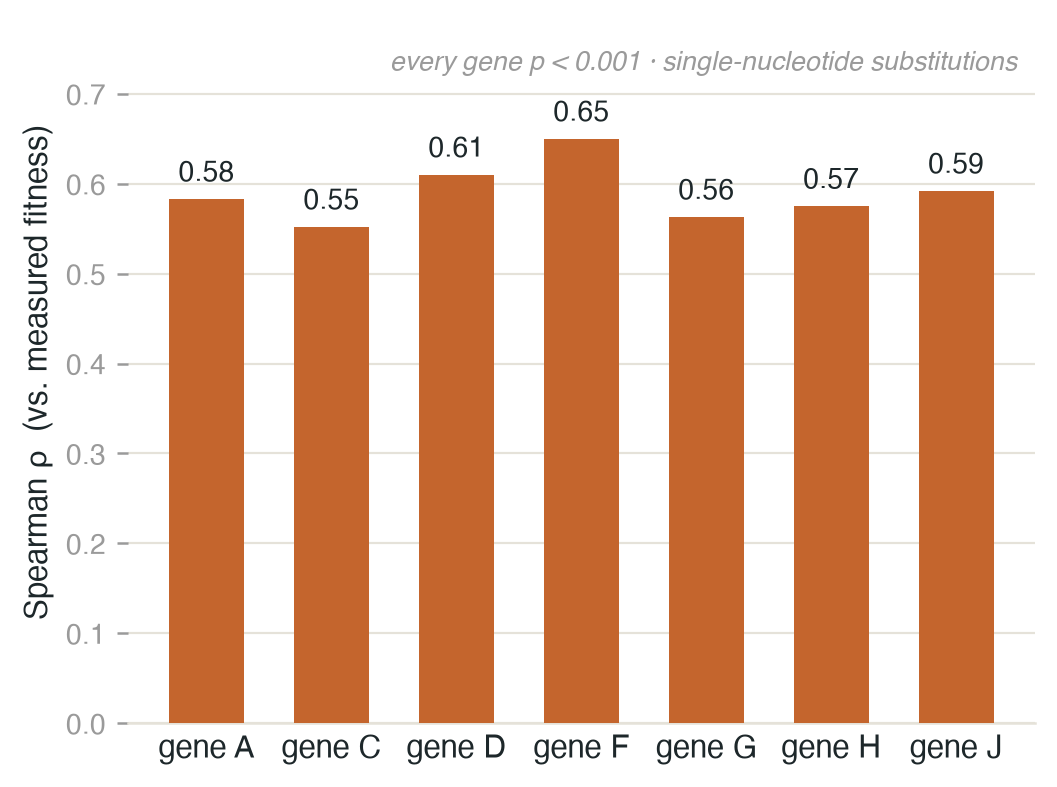
At the nucleotide level — a comparison no prior study could make, since no protein model can be scored on raw DNA — Evo2's own predictions correlate strongly and consistently with measured fitness for every gene with an unambiguous reading frame: Spearman ρ=0.55–0.65 (all p<0.001). Genes B, E and K have no such unambiguous nucleotide positions at all — every base in them also sits inside another gene's overlapping reading frame, a real quirk of ΦX174's densely packed genome, not a gap in the analysis.
Caveat worth keeping attached to any of this: this is zero-shot in the sense that the fitness measurements were never a training target — the same situation every protein model in the comparison faces with ΦX174's own proteins — but ΦX174 (the first DNA genome ever sequenced) was almost certainly present somewhere in Evo2's training data, so it is not a test of generalization to a genuinely unseen genome.
evo2_1b_base) turned out to require FP8 precision and a Hopper-class GPU per Evo2's own requirements — corrected to evo2_7b_base, which runs in plain bf16 on any CUDA GPU with enough memory, before any compute was spent| Data | The Lehner-lab ΦX174 complete-mutagenesis dataset (Wei, Li & Lehner, bioRxiv 2026, CC-BY): 16,098 single-nucleotide and 28,380 single-amino-acid substitutions across the phage's 11 overlapping genes, each with a measured fitness effect from a competitive growth assay, plus the paper's own published scores from ~15 protein variant-effect predictors for direct comparison. Reference genome: NCBI NC_001422, adjusted for the library's own 4-site strain difference. |
|---|---|
| Method | Zero-shot scoring with Evo2-7b-base (Arc Institute/NVIDIA, StripedHyena 2 architecture, pretrained on 8.8 trillion nucleotides across bacteria, archaea and phage): for every variant, the delta between the mutant and wild-type genome's model log-likelihood, correlated (per-gene Spearman) against measured fitness — matching the source paper's own evaluation exactly. |
| Compute & cost | Colab A100 (plus one Colab L4 comparison run) · roughly a day of wall-clock GPU time across ~9 session-preemption/resume cycles. |
| Deliverable | A DNA-model entry in the paper's own protein-VEP ranking table (16th of 35, mean ρ=0.257) plus a first-of-its-kind nucleotide-level result (ρ=0.55–0.65) that no prior study could produce, since no protein model can be scored on raw DNA. |
| Baseline to beat | The paper's own published predictor rankings — best tested is ESCOTT (ρ=0.54), weakest tested here is Tranception-L without retrieval (ρ=0.01). |
| Pitfall watch | ΦX174 was almost certainly present in Evo2's pretraining data, so this is seen-genome/unseen-phenotype zero-shot, not held-out-genome generalization. Amino-acid-level mutant genomes use a reconstructed minimal-nucleotide-change codon where the exact library codon isn't recoverable from the data — same protein effect, negligible DNA-level noise. |
| Risk | Low on the headline numbers — the full designed variant set was scored and evaluated with the paper's own metric on identical rows. The nucleotide-vs-amino-acid gap (nt-level correlations run higher than aa-level for every gene in common) is a genuine open question, not yet explained. |